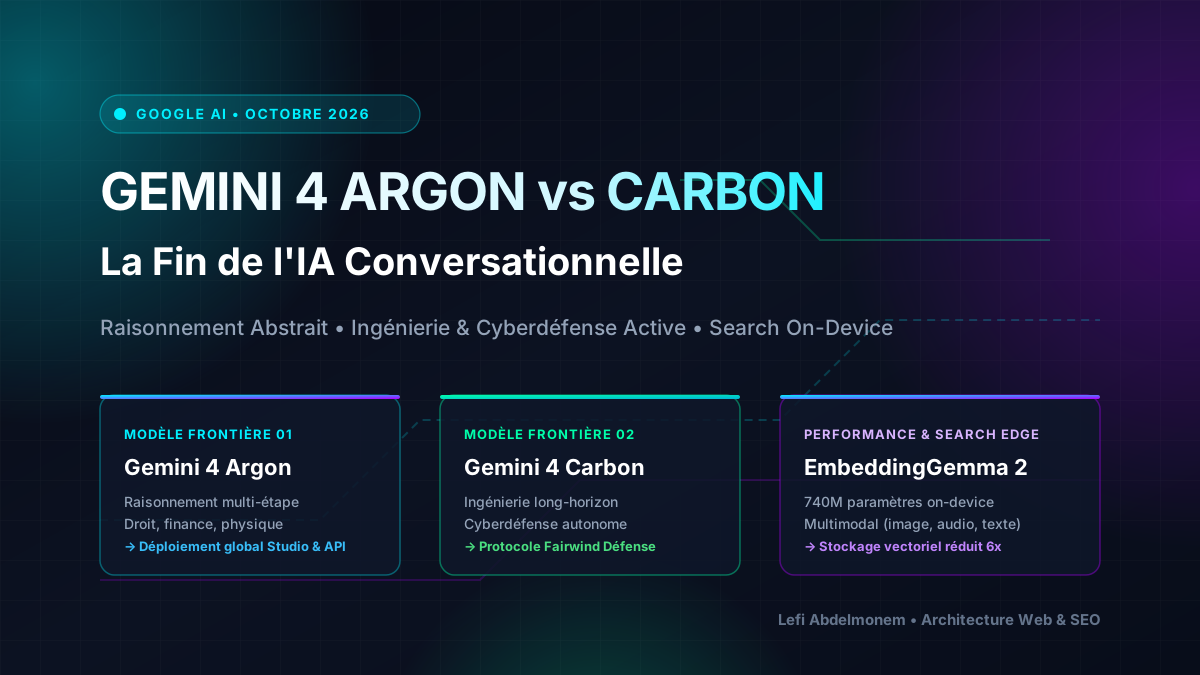
In its monthly recap published in early November 2026, Google laid out an extraordinary catalog of announcements: interactive real-time physics simulation via Genie 4, a peer-reviewed clinical milestone in The Lancet for its medical diagnostic AI AMIE, a haiku beamed back from a TPU satellite prototype (Project Suncatcher), and a 40-fold error reduction on the Willow quantum chip published in Science.
Yet for anyone designing backend architectures, running high-volume e-commerce platforms like PrestaShop, or battling performance latency and infrastructure vulnerabilities, the actual tectonic shift is concentrated in three simultaneous releases:
- The rollout of Gemini 4 Argon (frontier reasoning model), followed two weeks later by Gemini 4 Carbon (long-horizon autonomous engineering and cyber defense);
- The release of EmbeddingGemma 2, an open 740-million parameter multimodal embedding model running entirely on-device with a 6x vector compression factor;
- The global expansion of SynthID Detector to certify media authenticity across Google, OpenAI, Apple, and NVIDIA ecosystems.
1. The Great Bifurcation: Gemini 4 Argon vs Gemini 4 Carbon
For the past two years, AI research prioritized deliberative Chain of Thought (CoT). Gemini 4 Argon represents the pinnacle of this approach: an analytical powerhouse capable of parsing convoluted legal contracts, solving intricate physical theorems, and dissecting mathematical proofs with unmatched symbolic rigor.
Yet real-world engineering is not about producing rhetorical proofs. It is about fixing crashed microservices, resolving broken dependencies, patching compromised heaps, and maintaining zero-downtime databases under live traffic.
Enter Gemini 4 Carbon. Specifically architected for long-horizon engineering, Carbon is not tuned to chat: it is engineered to take ownership of a mission. Where Argon generates a self-contained answer, Carbon executes stateful tasks: it explores entire Git repositories, runs containerized unit test suites, inspects runtime telemetry, fails, course-corrects, and persists until the objective is accomplished.
| Evaluation Metric | Standard Generative LLM | Gemini 4 Argon (Reasoning) | Gemini 4 Carbon (Agentic / Cyber) |
|---|---|---|---|
| Primary Mission | Text generation, summarization, conversational help | Complex multi-step analytical reasoning (Finance, Law, STEM) | Autonomous software engineering, deep refactoring & active cyber defense |
| Autonomy Horizon | Instantaneous (single request / response cycle) | Minutes (tree-of-thought exploration & self-correction) | Hours to Days (multi-file project workflows, test regressions) |
| OS & Runtime Interaction | None (passive sandbox environment) | Ephemeral Python code execution scratchpad | Full terminal access, CLI tools, network calls, Git operations, CI/CD |
| Availability & Governance | Broad public (Gemini App, Studio, REST API) | Developer APIs, enterprise tiers, research institutions | Gated (U.S. Fairwind Program with cyber defense teams & federal agencies) |
| Handling Software Errors | Apologizes and offers another plausible hallucination | Analyzes stack traces and explains the conceptual flaw | Spins up an ephemeral container, reproduces the bug, compiles the patch, and validates tests |
Why the Fairwind Program Previews the Future of Software Security
The fact that Google pre-released Carbon under the Fairwind Program (dedicated to vetted cyber defenders and national defense infrastructure) is telling.
Consider the recent worldwide fallout from PHP2Shell (CVE-2026-109618 / 109619), which compromised memory allocators across 75% of open-source CMS ecosystems. The core danger was not identifying the memory corruption: it was the speed asymmetry between automated botnets weaponizing the longjmp heap corruption within seconds, and human DevOps teams struggling to validate and deploy emergency patches over weeks.
An action model like Carbon fundamentally alters defensive economics: it can continuously monitor server telemetry, flag anomalous memory access in real time, synthesize an inline WAF mitigation rule, and generate a pull request with regression tests before an attacker has finished their automated port scan.
2. EmbeddingGemma 2: Why Cloud Vector SaaS is Heading for Obsolescence in E-Commerce
While Carbon claims industrial computation headlines, EmbeddingGemma 2 represents the opposite pole: frugal, decentralized on-device intelligence.
Historically, offering advanced catalog search on an e-commerce storefront—such as semantic intent discovery, smartphone photo product matching, or voice queries—required a steep compromise:
- Subscribing to a proprietary cloud embedding API (charged per token or per query);
- Accepting unavoidable network latency (180 to 450 ms round-trip time) that directly penalizes Time to First Byte (TTFB) and Interaction to Next Paint (INP);
- Transmitting confidential shopper search queries and browsing histories across third-party infrastructure, exposing merchants to severe GDPR and privacy liabilities.
EmbeddingGemma 2 dismantles this SaaS tax. With 740 million parameters and native compression algorithms, it projects text, source code, video, and audio into a single unified geometric vector space while shrinking vector storage requirements by 6x.
| Architecture Dimension | Legacy Cloud Vector Search (SaaS APIs) | On-Device / Edge Search (EmbeddingGemma 2) |
|---|---|---|
| Cost Structure | Continuous Opex (metered per API call / per visitor query) | Zero marginal cost (runs on your server, Cloudflare Worker, or client device) |
| Search Latency (TTFB) | 180 ms to 500 ms (datacenter network hops) | Sub-millisecond in browser memory or < 10 ms on Edge nodes |
| Native Modalities | Fragmented (separate text and computer vision endpoints) | Unified latent space: Text, Image, Audio, and Code combined |
| Offline Availability | Impossible (dependent on constant cloud connectivity) | 100% operational in local apps, PWAs, or intranet environments |
| Data Privacy & GDPR | User shopping intent leaked to third-party providers | Zero-Knowledge: vectors are computed client-side without leaving the browser |
3. SynthID Detector vs C2PA: The Battle for Digital Provenance in Search
By making its SynthID Detector globally available and disclosing that over 180 billion media items have already been watermarked, Google has signaled a major warning to the web publishing industry: unverified synthetic generation will no longer pass unnoticed.
Since the rollouts of AI-Organized Search Results and recent spam policy updates, mass-produced synthetic content has turned into an algorithmic liability. Two competing architectures are currently vying to define the future of digital verification:
| Property | C2PA Standard (Content Credentials) | SynthID Detector (Google & Industry Coalition) | Heuristic / Perplexity Detectors |
|---|---|---|---|
| Mechanism | Cryptographic manifest signature injected in EXIF/XMP metadata | Imperceptible steganographic watermark embedded in pixel/audio frequencies | Statistical analysis of text entropy and lexical repetition |
| Tamper Resistance | Extremely fragile: stripped by screenshots, image compression, or CMS uploads | Resilient: survives filters, crops, aggressive JPEG compression, and resampling | Unreliable: high false positive rates, easily fooled by basic paraphrasing |
| Search Engine Crawling | Passive metadata inspection (frequently discarded) | Directly integrated into Googlebot, Chrome, and Search ranking signals | Secondary, non-systemic quality signals |
| Industry Coalition | Adobe, Microsoft, Leica, Sony, Truepic | Google DeepMind, OpenAI, Apple, NVIDIA, Kakao | Fragmented third-party SaaS startups |
For e-commerce operators, the stakes are concrete: Google's Shopping Graph is actively using these models to distinguish real, physical inventory photography from synthetic generative mockups. Demonstrating genuine product possession is rapidly becoming an indispensable pillar of commercial E-E-A-T.
4. Strategic Roadmap: Engineering Your Infrastructure for 2027
How should engineering leads and store owners prepare their web stack for this reality? Here are three fundamental rules:
A. Shift to the Agentic Standard (WebMCP)
Because models like Carbon are built to navigate, diagnose, and trigger actions, your site can no longer remain just a graphical visual shell for human eyeballs. Implement the WebMCP (Model Context Protocol for Web) standard to expose verified inventory endpoints, schemas, and operational tools directly to autonomous buying agents.
B. Move Routine Intelligence to the Edge
Do not lock your infrastructure into a dependency on metered cloud LLM APIs for routine operations. Reserve frontier models (Argon, Carbon) for high-stakes reasoning and autonomous remediation. Run catalog indexing, autocomplete, and visual search locally using compact models like EmbeddingGemma 2 to safeguard your Time to First Byte.
C. Sign and Safeguard Your Data Feeds
With the upcoming enforcement of the shared AI training robots.txt token and deep watermarking via SynthID, authoritative schema markups and verified first-party data are your most valuable defensive moats. Original, human-curated product specifications will capture the highest commercial premium in search.
Conclusion: The Era of Builders
October 2026 marks the end of the parlor trick era in artificial intelligence. Prompt tinkering is taking a back seat to rigorous software engineering, systems telemetry, and edge execution.
Those who orchestrate the convergence of autonomous action agents (Carbon), zero-latency multimodal edge search (EmbeddingGemma), and high-performance e-commerce architecture will build the definitive web platforms of the next decade.